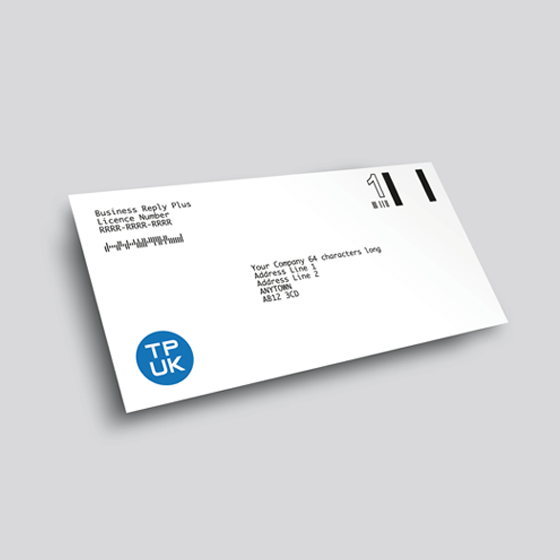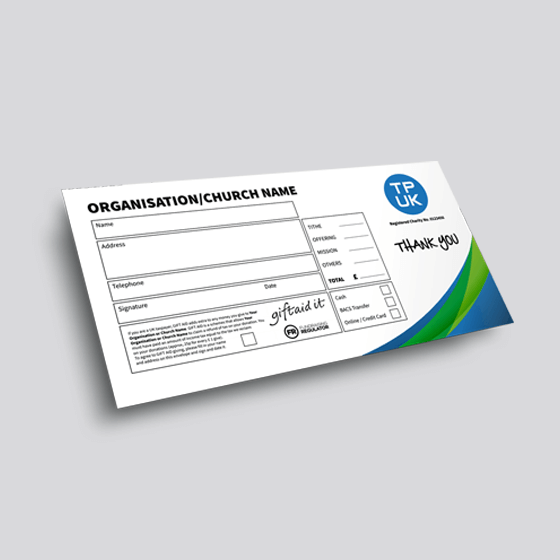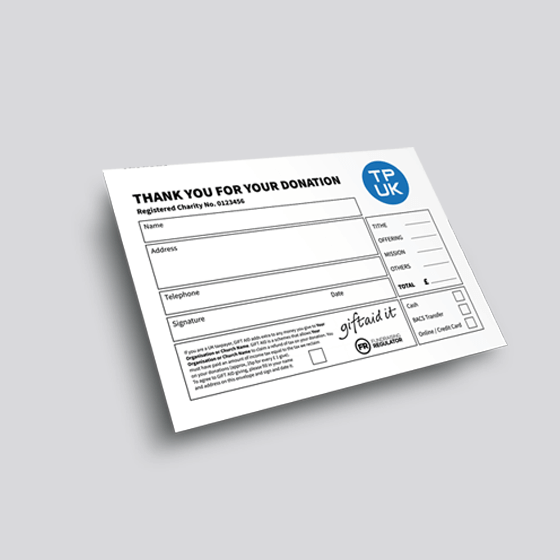
Colour Envelope Printing
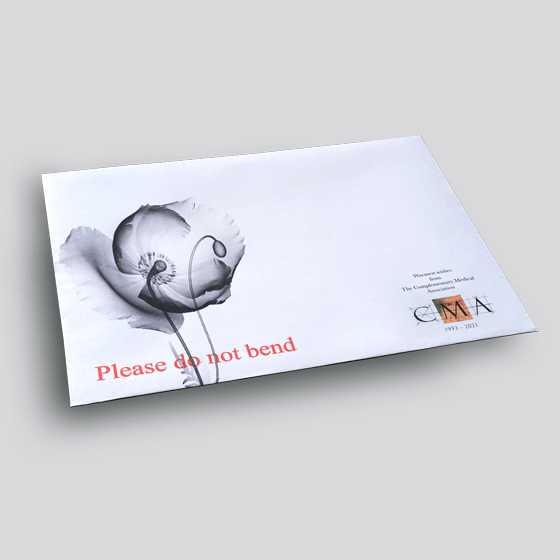
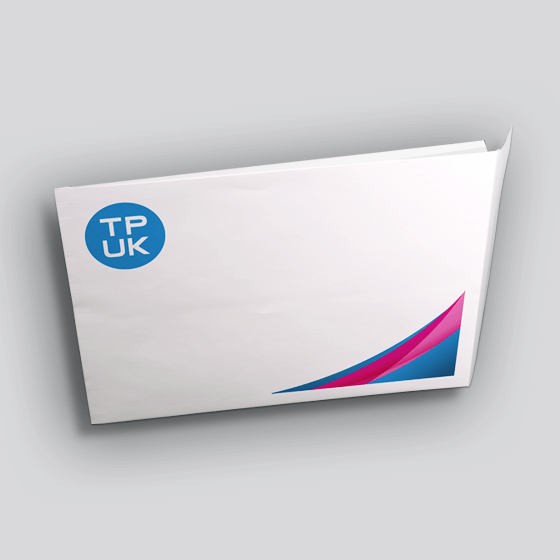
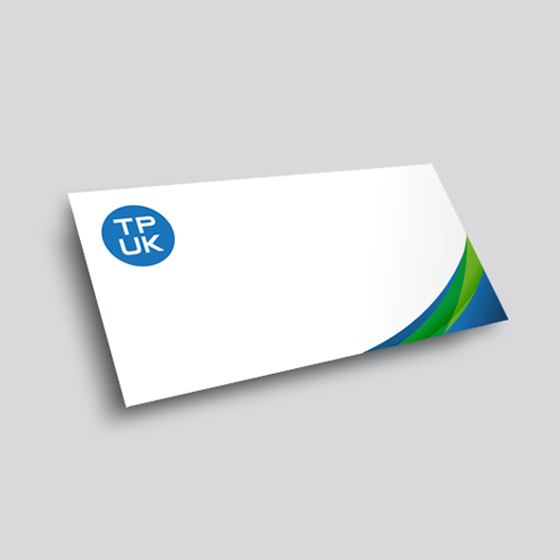
There are lots of types of printed envelopes available (both single colour and full colour), but we've standardised on printing the main European and UK sizes of A6, DL, C5 and C4 envelopes and TradePrintingUK (TPUK) consider ourselves to be a one of the top envelope printers in the country.
We always use the premium Crusade Envelope brand which gives a high-white, high-quality finish, and there are both window and non-window variants available. We mainly use the shorter life 'Self-Seal' type which are sealed by pressing together two flaps that are both pre-gummed. Over time (less than a year) they are prone to drying out in warmer office conditions, but are less expensive to produce and the majority of our clients prefer them due the advantage of less waste (those little white peel-off strips on Peel & Seal envelopes have to be dumped somewhere!) and they are normally used quite quickly for specific mail-outs or in a normal office environment. Our advice: order less at a time!
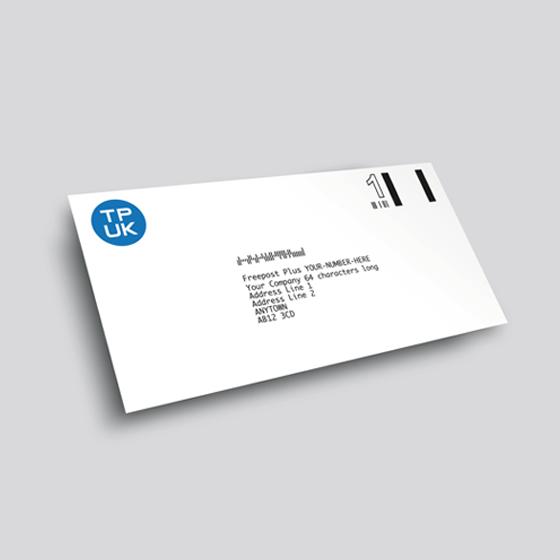
PRINTING ROYAL MAIL BUSINESS REPLY & FREEPOST ENVELOPES
One of the main uses of printed envelopes we find are for Business Reply Envelopes and Freepost Envelopes posted via the Royal Mail so quality has to be excellent to work within their stringent printing guidelines, especially with overprinting 1st and 2nd class indicia and barcodes to pass your mail quickly through their automated machinery.
We have some of the finest Royal Mail envelope templates in the country (TPUK's are probably even better than what they supply themselves, so we've been told!) as they are optimised for their systems, so you look good and have a hassle-free relationship with them.
PRODUCTION NOTES
All envelope descriptions are for guidance only as exact dimensions are subject to the usual tolerances that occur during the manufacturing process. In particular, flap shapes and sizes vary depending on the precise manufacturing machinery. Even within the same factory, older machines which are used from time to time may produce different designs of a particularly flap. The envelopes you receive may be subject to minor design variances, however, these variances will neither affect the functionality nor the perception of quality of the envelopes.
Envelopes are made from various weights of paper, usually from 90gsm to 100gsm. (gsm = grams per square metre). We would advise that he larger the envelope the more important the weight becomes; without the additional weight they become floppy and tear easily as you put papers or card inside.
Self-Seal Envelopes are usually produced in 90gsm
Peal & Seal Envelopes are produced in 100gsm
We print DL, C5 & C4 Envelopes in 1 & 2 Spot Colours or Full Colour CMYK. Different branded envelopes and envelopes stules are available on request.
Who are TradePrintingUK?
We are part of the Xpress Printing Group and were established in 1992. Based in Mallusk, Newtownabbey we pride ourselves in offering only the highest level of service and production quality to both the trade and retail.
We fully appreciate that the work we do is usually for Re-sale within the trade and our design and production teams realise that we are another manufacturing arm for your business and have pride in doing so.
We are only interested in helping you to meet YOUR customer's deadlines by providing fast turnarounds and quality printing to yourselves.
Our reputation is one of integrity - We will NEVER contact your customer directly!
We use strong, double-walled, generic white boxes. For packaging heavier items up to 30Kg we double-pack for even better transit strength.
Our mailing label is the only thing that will have a discreet return address (as PARCELFORCE require it obviously), but that will be easily removed once you receive it at your end. As far as your customer will be aware, their job was printed and produced BY YOU!
Artwork Templates
Free Artwork Templates are available in our Templates Section. You can download the one that suits and make changes to it yourself or we can do it for you. Let us know what template you would like to use along with the details you want on it and we'll provide you with the artwork. Useful for Invoice Books, Purchase Orders, Delivery Notes, Receipt Books, Work Dockets etc.
Re-Ordering jobs at a later date
We keep existing jobs in our archives and the digital artwork backed up onto DVD-R discs for at least 4 years, making Re-Ordering jobs much easier as far as colour matching, sequential numbering continuation etc.
Just phone us with a description of the previous job, quantity required and your details and we'll do the rest.
Terms and Conditions
Before ordering from TradePrintingUK.com you should read our Terms and Conditions.
Payment With Order
Due to our cheap printing prices, we only offer our services on a purely PAYMENT-WITH-ORDER* basis. Thus payment is required before production is started. Alternatively if you work on a ProForma-based invoice system whereby you've to raise an Purchase Order Number first before anything can proceed then we can work with you on that too. We can accept all types of regular UK Credit Card / Debit Cards (with exception to American Express), or you can use a BACS / CHAPS transfer, but that will require 3-4 additional working days' clearance. Business cheques will still require 6 working days for clearance before production begins. Our bank details are available on request from our Accounts dept.
*Printing.com franchises have a special arrangement in place. Please contact our Accounts dept for further details.
Credit / Debit Cards -- instant payment (you'll get up to 45 days credit with your Credit Card anyway) and production is initiated from day of payment.
Personal / Business Cheques -- 6 working days' clearance required before production proceeds
BACS transfer -- 3-4 working days' clearance required before production proceeds
CHAPS transfer -- 1-2 working days' clearance required before production proceeds
FPS transfer -- 1 working day clearance required.
Banks using FPS (at July 2008):
Abbey, Alliance and Leicester, Barclays, Citi, Clydesdale and Yorkshire Banks (National Australia Group), Co-operative Bank, HBOS, HSBC, Lloyds TSB, Nationwide Building Society, Northern Bank (Danske Bank), Northern Rock, and Royal Bank of Scotland Group (including NatWest and Ulster Bank).
But can I not have a 30-day Account? I've good references.
Our larger customers with established 30-day Accounts spend from £5k+ a year turnover.
But remember -- If you use your Credit Card you'll automatically be gaining up to 45 days' credit from your Bank anyway, which is even better terms than we could offer you.
What is NCR?
It means "No Carbon Required" and is a carbonless copy paper used to make a copy of an original, handwritten document. It's a biogradable, stain-free alternative to the old-style black or blue carbon-based papers that one used to sandwich between two other pages. They were very messy! NCR works by the pressure from the point of a pen releasing (by breaking) micro-capsules of dye ink onto the page below. As they are so tiny, the replicated print results in a very accurate, though slightly lighter copy.
NCR jobs are probably our most popular product.
But what's the difference between an NCR Set, NCR Pad and NCR Book?
A common question.
May we first suggest clicking on the comparison links ('What are NCR Sets?' etc.) on each page.
Basically:
An NCR SET is a duplicate or triplicate pair of lightweight 70gsm pages, that can be any sheet colour (White, Pink, Yellow, Green or Blue), that is then over-printed with your supplied artwork. So a 2pt (pt = Part = Page) Set would have a Top Sheet and a Bottom Sheet.
What can you use NCR for?
Carbonless forms and stationery can have lots of everyday uses, but the most popular NCR carbonless products that folks in the UK use are "Invoice pads" and "invoice books"'; "Receipt pads" and "Receipt books"; courier and logistics companies use "Delivery pads" and "Delivery books"; the catering trades use a lot of "Restaurant Pads" and "Waiter pads"/"Waitress Pads"; landlords and letting agents use "Rent Books" and "Rent Receipt Books" to keep track of their house and apartment lets; the manual trades use a load of "Docket books", and "Job pads"; the building trade must have "Safety pads", "Order pads", "Order dockets" and Order books"; "Estimate Pads" and "Estimate Books" which are similar to "Enquiry pads" and "Enquiry books", "Works dockets" and "Work books"; offices and accounts departments would be lost without "Purchase Order pads" and "Purchase Order books", "Cash Sale Forms" and "Cash Sale Books" and everything is available to print bespokely with your company's logo, name and address details as either "Duplicate Pads" and "Duplicate Books", "Triplicate Pads" and "Triplicate Books", or even the big "Quadruplicate Pads" and "Quadruplicate Books" meaning you can bespoke them any way you wish whether into duplicate (two part/2pt), triplicate (three part/3pt) or quadruplicate (four part/4pt), whilst giving you the choice of the colour combination of the paper used to set off your design nicely. NCR carbonless printing is really a useful way to productively enhance your business.
What file formats do you accept?
TradePrintingUK prefered file format is a high-resolution PDF
What are your sizes for printed Stationery and Flyers?
| Name |
Supply Artwork at |
Finished Trim Size |
| 1/3 A4 |
105mm x 216mm |
99mm x 210mm |
| A6 |
105mm x 154.5mm |
99mm x 148.5mm |
| A5 |
154.5mm x 216mm |
148.5mm x 210mm |
| A4 |
216mm x 303mm |
210mm x 297mm |
| A3 |
303mm x 426mm |
297mm x 420mm |
I've been working in RGB on CorelDraw or other non-Photoshop software. Why do the colours in the job look differently on my monitor when you send me the pre-production proof?
The colour gamut that is produced by rays on light (in RGB) on your monitor is much much wider than is physically achievable with any printing inks, which use a much smaller gamut.
What Bleed do you use?
If you have an image, text or other artwork that extends right to the edge of the page, the final dimensions must extend off the page and beyond the final trimmed dimensions of the job.
For NCR jobs -- add 3mm to each side (See further notes in our 'Supplying Artwork' section).
For Spot Colour jobs, add 3mm to each side.
For CMYK jobs like Flyers & Stationery, please add 1.5mm bleed to each side.
I want to have a Silver or Gold-type colour. Do TradePrintingUK.com use those inks?
We don't print with either Pantone 877 Silver or Pantone 871 Gold metallic inks. But there are workarounds to achieve something similar. There'll be no metallic fleck though.
To achieve Imitation Silver - use a tint of Black around 25%. You could also try a linear blend from 25% - 50% Black.
To achieve ImitationGold (out of CMYK process), we use a great full colour mix in the relevant products of 29C, 42M, 69Y which achieves delightful results.
Any good design tips?
1) Try and keep any important text you have (like addresses, phone numbers etc. at least 5-10mm away from the trimmed edge. That will allow for guillotine tolerance from the top of the paper pile to the bottom.
2) Don't print with white borders on your artwork. It just looks bad and will never be symmetrically even no matter how carefully it is printed & guillotined.
3) Note that Photoshop's default Black & White (the diagonal black & white blocks on the main tool bar on the left) aren't actually that. The White in that swatch is actually "Page White" meaning 1C, 2M, 2Y. The Black is a 4-plate Black by default of 91C, 81M, 81Y, 91K. So make up your own "Pure White" -- 0C 0M 0Y 0K and add that Swatch to the Swatches palette; and two different Blacks -- "Pure Black" -- 0C 0M 0Y 100K, and "SuperBlack" (for large areas of flat Black colour) - 50C, 0M, 0Y, 100K.
4) For Photoshop -- work in either Grayscale mode exclusively to make individual mono plates, or in CMYK only (just in Magenta & Black plates/channels). Do not work in RGB! That is for website use only.
5) In Illustrator, make sure you Create Outlines before submitting any jobs, or creating PDFs etc.
6) Work at a resolution of 350dpi for all design work, that way any fine text weights or small sizes (4pt to 6pt) will print much more clearly.
All text above is Copyright © TradePrintingUK.com / Xpress Printing Group 2008